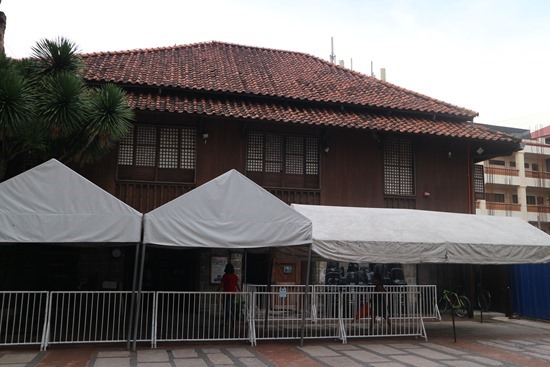
I visited the Church of Saint Joseph in Las Piñas several times from 2001-2005. At that time, I was working as assistant to the site supervisor in our project in Bacoor, Cavite. It’s the town next to Las Piñas if you’re going to Cavite province.
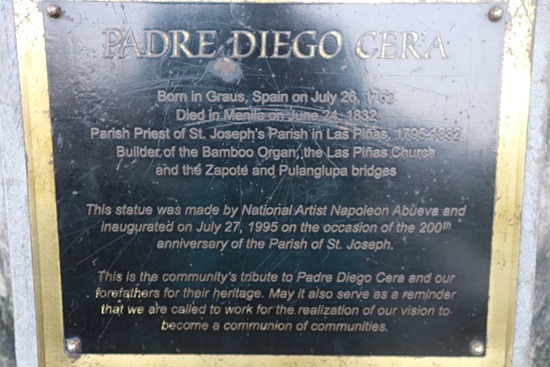
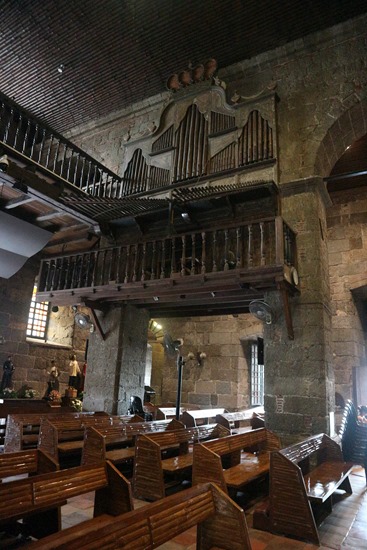
I recently went back to Saint Joseph Cathedral to take pictures of the church, which is famous for the Bamboo Organ. There are several markers on the façade of the church which briefly states its history. There is also a statue dedicated to the founder of this church, Padre Diego Cera. The statue was made by the late National Artist Napoleon Abueva.

Simbahan ng Las Piñas
Itinatag bilang Pueblo, 1762. Inihiwalay sa Parokya ng Parañaque, 1775. Itinalagang unang naninirahang kura paroko si P. Diego Cera dela Virgen del Carmen, Disyembre 26, 1795. Ipinatayo niya ang simbahang bato, 1797-1819 at ang organong yari sa 902 tubong kawayan at 129 tubong lata, 1816-1824. Bahagyang nasira ng lindol, 1828 at 1863. Dahil sa magkakasunod na paglindol noong 1880, ito ay hindi na pinagdausan ng misa. Ipinakumpuni noong 1883 subalit hindi ito ganap na naisaayos. Ginamit na kampo ng mga bihag noong panahon ng pananakop ng mga Hapon at bilang pagamutan noong Liberasyon. Ibinalik sa dating kaayusan sa pamamagitan ng magkasamang pagpupunyagi ng Parish Community at ng Historical Conservation Society, 1962-1977.
(Church of Las Piñas
Established as a Pueblo, 1762. Seperated from Parañaque Parish, 1775. Father Diego Cera dela Virgen del Carmen was assigned as the first resident parish priest, December 26, 1795. He commissioned the building of the stone church in 1797-1819 and the (bamboo) organ, which is build from 902 bamboo tubes and 129 tin tubes, from 1816-1824. Slightly damaged by an earthquake in 1828 and 1863. Due to a series of earthquakes in 1880, masses where never celebrated in this church. It was repaired in 1883 but was not completely restored. (This church) was used as a camp for prisoners of war during the Japanese Occupation and as a hospital during the Liberation. It was restored to the old design/condition through the efforts of the Parish Community and the Historical Conservation Society, 1962-1977)
Simbahan ng Parokya ng San Jose, Las Piñas
Ipinahayag bilang pambansang palatandaang pangkasaysayan sa bisa ng Resolusyon Blg. 08 ng Pambansang Komisyong Pangkasaysayan ng Pilipinas, 15 Hulyo 2013.
(Parish Church of Saint Joseph, Las Piñas
Declared as a National Historical Marker/Treasure by virtue of Resolution Number 08 by the National Historical Commission of the Philippines, July 15, 2013)
Padre Diego Cera
Born in Graus, Spain on July 26, 1762
Died in Manila on June 24, 1832
Parish Priest of St. Joseph’s Parish in Las Piñas, 1795-1832
Builder of the Bamboo Organ, the Las Piñas Church and the Zapote and Pulanglupa bridges
This statue was made by National Artist Napoleon Abueva and inaugurated on July 27, 1995 on the occasion of the 200th anniversary of the Parish of St. Joseph.
This is the community’s tribute to Padre Diego Cera and our forefathers for their heritage. May it also serve as a reminder that we are called to work for the realization of our vision to become a communion of communities.